
HPV (Human papillomavirus) is responsible for around 100,000 new cancer cases in Europe every year, primarily cervical cancer (1, 2). In Germany, approximately 7,850 HPV-related cancers are diagnosed annually, affecting the cervix, oropharynx, anus, vulva, vagina and penis, with cervical cancer accounting for the largest proportion (3).
Human papillomavirus comprises over 200 genotypes, of which high-risk types, particularly HPV16 and HPV18, are responsible for the majority of HPV- related malignancies, including cervical, anal, vulvar, vaginal, penile, and oropharyngeal cancers. HPV16 and HPV18 together account for approximately 70% of cervical cancers worldwide, while HPV is responsible for approximately 90% of cervical and anal cancers, around 70% of vaginal and vulvar cancers, more than 60% of penile cancers, and 70–90% of oropharyngeal cancers. Additional oncogenic types (31, 33, 45, 52, and 58) further contribute to carcinogenesis (4, 5, 6, 7).
Clinical Manifestations
From a clinical perspective relevant to general practice, genital HPV infection most commonly presents as:
- Anogenital warts, involving the vulvar, vaginal, cervical, penile, scrotal, and perianal regions. These lesions are typically multiple, papular, flat, or filiform, with a hyperkeratotic appearance on keratinized skin or macerated aspect on mucosal surfaces. They are often asymptomatic but may cause pruritus or discomfort.
- Precancerous lesions, grouped under anogenital intraepithelial neoplasia
- Anogenital and Cervical Cancer. Persistent infection with high-risk HPV types can lead to intraepithelial neoplasia that may progress to invasive carcinoma.
- Oropharyngeal cancers resulting from persistent high-risk HPV infection are increasingly observed in younger patients and now represent a major etiological factor independent of traditional risks such as tobacco and alcohol use (8).
Available Vaccines and Coverage Challenges
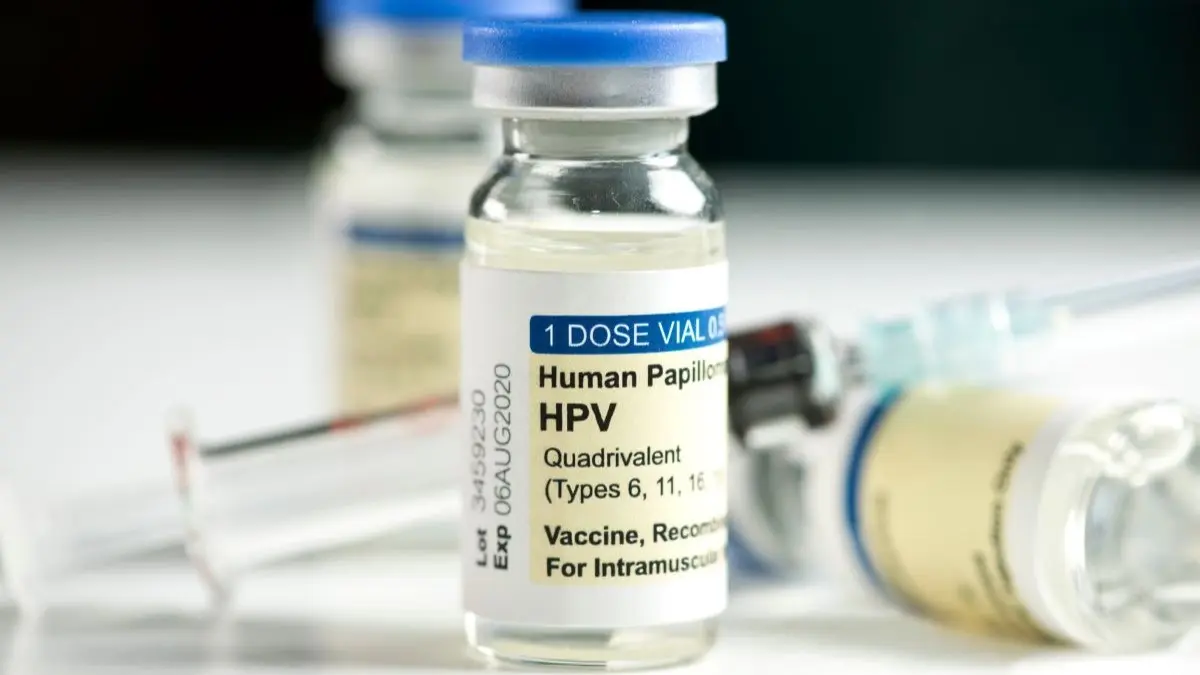
There are 4 HPV vaccines available: Cervarix (HPV 18, 16), , Gardasil 9 (6, 11, 16, 18, 31, 33, 45, 52, 58).
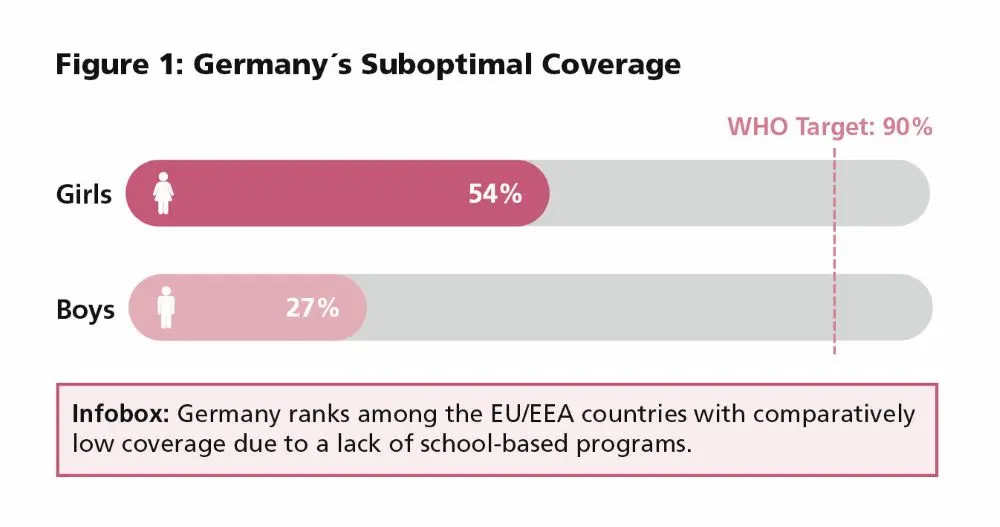
Despite the availability of effective vaccines, HPV vaccination coverage remains suboptimal. In Germany, only 54% of 15-year-old girls and 27% of 15-year-old boys had completed HPV vaccination in 2021, placing Germany among the EU/EEA countries with comparatively low HPV vaccination coverage (9, 10).The first HPV vaccine was licensed in the European Union in 2006 while in Germany it has been recommended since 2007 (11).
© mgb-medizin
Vaccination Recommendations and Implementation
Current guidelines advise vaccination for girls and boys aged 9–14 years, ideally before the onset of sexual activity. Catch-up vaccination is also recommended up to 17 years in Germany (12, 13, 14).
According to the Standing Committee on Vaccination (STIKO), HPV vaccination is recommended for all girls and boys aged 9–14 years. In 2018, the recommendation was extended to boys (gender-neutral policy). A two-dose schedule is recommended, with an interval of at least 5 months between doses (13, 14, 15).
Catch-up vaccination is recommended for adolescents aged 15–17 years using a three-dose schedule. Beyond 17 years of age, there is no universal STIKO recommendation, although vaccination may still be performed following individual medical consultation (12, 15).
In Germany, HPV vaccination is primarily delivered through office-based physicians, particularly pediatricians. However, the absence of organized school-based vaccination programs and systematic reminder systems has been identified as an important factor contributing to comparatively low HPV vaccination coverage (16, 17).
Countries with school-based vaccination programs achieve significantly higher coverage, suggesting a potential model for improvement (18, 19).
© mgb-medizin
Real-World Effectiveness and Impact
HPV vaccines are highly effective, especially when administered at younger ages, before the first sexual contact. Studies have demonstrated up to a 90% reduction in HPV-related disease, significant decreases in cervical cancer and precancerous cervical lesions, and strong herd immunity effects in highly vaccinated populations (20, 21, 22, 23).
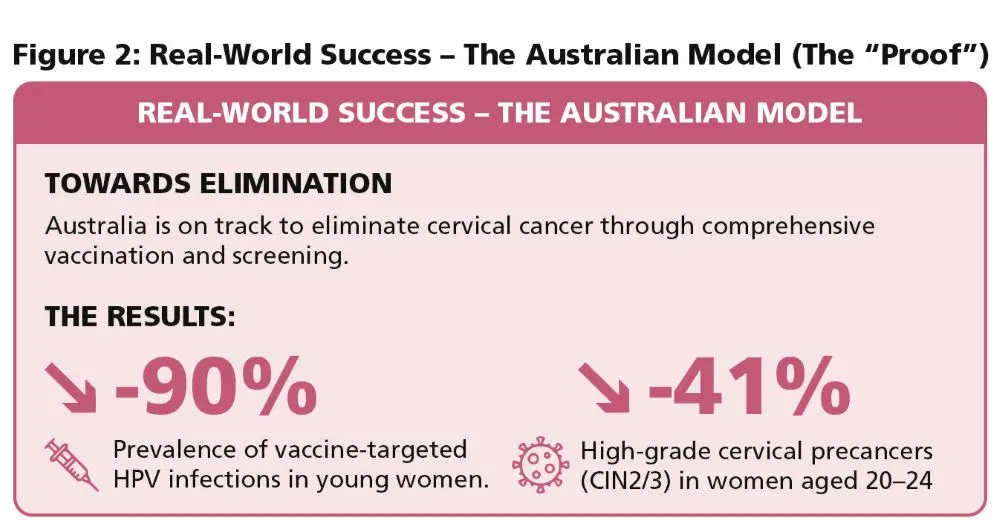
Australia is poised to become the first country to approach the elimination of cervical cancer because it has fully implemented comprehensive HPV vaccination, HPV-based cervical screening, and high-quality treatment of precancerous lesions (24, 25, 26). Multiple studies have documented substantial improvements in health outcomes: the prevalence of vaccine-targeted HPV infections in young women has fallen by approximately 90%, including reductions among unvaccinated women due to herd immunity; the prevalence of anogenital warts has declined markedly in females and heterosexual males; high-grade cervical precancer (CIN2/3) has decreased by approximately 41% among women aged 20–24 years; and rates of excisional treatment for cervical abnormalities have also declined in young women (27, 28, 29, 30).
Safety Profile and Conclusion
As safety is an important consideration, HPV vaccines have demonstrated an excellent safety profile. Most adverse events are mild and localized, such as pain, redness, or swelling at the injection site (31, 32). Serious adverse events are extremely rare, and large-scale epidemiological studies and systematic reviews have found no evidence of a causal association between HPV vaccination and autoimmune, neurological, or other chronic disorders (33, 34, 35).
HPV vaccines remain one of the most effective infectious disease prevention tools in modern medicine, with ongoing evidence reinforcing long-term real-world effectiveness.
Corresponding adresse
Prof. Dr. Carmen Salavastru
Carol Davila University of Medicine and Pharmacy
Colentina Clinical Hospital
Bucharest, Romania
Website: https://umfcd.ro
References:
- European Cancer Organisation. Human papillomavirus (HPV) and cancer. https://www.europeancancer.org/content/hpv-and-cancer.html). Accessed June 26, 2026.
- World Health Organization. Human papillomavirus and cancer. Fact sheet. Updated March 5, 2024. https://www.who.int/news-room/fact-sheets/detail/human-papilloma-virus-and-cancer). Accessed June 26, 2026.
- Robert Koch Institute. RKI-Ratgeber: Humane Papillomviren (HPV). Updated December 22, 2023.https://www.rki.de/DE/Aktuelles/Publikationen/RKI-Ratgeber/Ratgeber/Ratgeber_HPV.html). Accessed June 26, 2026.
- de Martel C, Georges D, Bray F, Ferlay J, Clifford GM. Global burden of cancer attributable to infections in 2022: a worldwide incidence analysis. Lancet Glob Health. 2025;13(5):e609–e618.
- World Health Organization. Human papillomavirus and cancer. Fact sheet. Updated March 5, 2024. Available from: https://www.who.int/news-room/fact-sheets/detail/human-papilloma-virus-and-cancer
- International Agency for Research on Cancer. IARC Monographs on the Evaluation of Carcinogenic Risks to Humans. Volume 100B: Biological Agents. Lyon: IARC; 2012. Human papillomaviruses.
- Serrano B, Brotons M, Bosch FX, Bruni L. Epidemiology and burden of HPV-related disease. Best Pract Res Clin Obstet Gynaecol. 2018;47:14–26.
- Elrefaey S, Massaro MA, Chiocca S, Chiesa F, Ansarin M. HPV in oropharyngeal cancer: the basics to know in clinical practice. Acta Otorhinolaryngol Ital. 2014;34(5):299-309.
- Robert Koch Institute. Intervention Study to Increase HPV Vaccination Coverage in Germany (InveSt HPV). Berlin: RKI; 2023. Available from: https://www.rki.de/EN/Topics/Infectious-diseases/Immunisation/Research-projects/invest-hpv.html. Accessed June 26, 2026.
- European Centre for Disease Prevention and Control. The State of Health of HPV Vaccination Programmes in the EU/EEA. Stockholm: ECDC; 2026. Available from: https://www.ecdc.europa.eu/en/publications-data/state-health-hpv-vaccination-programmes-eueea. Accessed June 26, 2026.
- Kaufmann AM, Gissmann L, Schneider A. Human papillomavirus vaccination: a review of current status and recommendations in Germany. Deutsches Ärzteblatt International. 2008;105(26):455–462.
- World Health Organization. Human papillomavirus (HPV) and cervical cancer. Geneva: WHO; updated 2024. (Recommends routine vaccination of girls and boys aged 9–14 years before sexual debut.)
- Ständige Impfkommission. Empfehlungen der Ständigen Impfkommission (STIKO) beim Robert Koch-Institut 2018/2019. Epidemiologisches Bulletin. 2018;34.
- National Immunization Technical Advisory Group Resource Center. Background paper for the recommendation of HPV vaccination for boys in Germany. 2018. (Summarizes STIKO recommendation: vaccination at 9–14 years before first sexual contact; catch-up through age 17; two doses ≥5 months apart, three doses if vaccination starts at ≥15 years.)
- Kassenärztliche Bundesvereinigung. HPV-Schutzimpfung. Updated 2025. (Current implementation of STIKO recommendations: 9–14 years, two doses; ≥15 years, three doses; catch-up before age 18.))
- Horn J, Damm O, Kretzschmar M, et al. Uptake of HPV vaccination among boys after the introduction of gender-neutral HPV vaccination in Germany before and during the COVID-19 pandemic. Infection. 2023;51:265–276. (Describes the German office-based vaccination system and discusses factors influencing uptake.)
- Robert Koch Institute. RKI-Ratgeber: Humane Papillomviren. Updated 2023. (Describes HPV vaccination in Germany and the healthcare delivery structure.)
- World Health Organization. Human papillomavirus vaccines: WHO position paper – December 2022. Weekly Epidemiological Record. 2022;97(50):645–672.
- European Centre for Disease Prevention and Control. Guidance on HPV vaccination in EU countries: focus on boys, people living with HIV and 9-valent HPV vaccine introduction. Stockholm: ECDC; 2020.
- Centers for Disease Control and Prevention. (2024). Human papillomavirus (HPV) vaccination. https://www.cdc.gov/hpv/vaccines/index.html
- Drolet, M., Bénard, É., Pérez, N., Brisson, M., & HPV Vaccination Impact Study Group. (2019). Population-level impact and herd effects following the introduction of human papillomavirus vaccination programmes: Updated systematic review and meta-analysis. The Lancet, 394(10197), 497–509. https://doi.org/10.1016/S0140-6736(19)30298-3
- Falcaro, M., Castañon, A., Ndlela, B., Checchi, M., Soldan, K., Lopez-Bernal, J., Elliss-Brookes, L., Sasieni, P., & others. (2021). The effects of the national HPV vaccination programme in England on cervical cancer and grade 3 cervical intraepithelial neoplasia incidence: A register-based observational study. The Lancet, 398(10316), 2084–2092. https://doi.org/10.1016/S0140-6736(21)02178-4
- World Health Organization. (2022). Human papillomavirus (HPV) and cervical cancer. https://www.who.int/news-room/fact-sheets/detail/human-papillomavirus-(hpv)-and-cervical-cancer
- World Health Organization. (2020). Global strategy to accelerate the elimination of cervical cancer as a public health problem. Geneva: World Health Organization.
- Hall, M. T., M. T., Simms, K. T., Lew, J. B., Smith, M. A., Brotherton, J. M. L., Saville, M., Frazer, I. H., & Canfell, K. (2019). The projected timeframe until cervical cancer elimination in Australia: A modelling study. The Lancet Public Health, 4(1), e19–e27. https://doi.org/10.1016/S2468-2667(18)30183-X
- Canfell, K., K., Kim, J. J., Brisson, M., Keane, A., Simms, K. T., Caruana, M., … & Burger, E. A. (2020). Mortality impact of achieving WHO cervical cancer elimination targets: A comparative modelling analysis in 78 low-income and lower-middle-income countries. The Lancet, 395(10224), 591–603. https://doi.org/10.1016/S0140-6736(20)30157-4
- Drolet, M., M., Bénard, É., Pérez, N., Brisson, M., & HPV Vaccination Impact Study Group. (2019). Population-level impact and herd effects following the introduction of human papillomavirus vaccination programmes: Updated systematic review and meta-analysis. The Lancet, 394(10197), 497–509. https://doi.org/10.1016/S0140-6736(19)30298-3
- Smith, M. A., M. A., Lew, J. B., Simms, K. T., et al. (2015). Impact of HPV vaccination and primary HPV screening on cervical abnormalities and treatment in Australia. BMC Medicine, 13, 227. https://doi.org/10.1186/s12916-015-0476-4
- Tabrizi, S. N., S. N., Brotherton, J. M. L., Kaldor, J. M., et al. (2014). Fall in human papillomavirus prevalence following a national vaccination program. The Journal of Infectious Diseases, 210(11), 1645–1652. https://doi.org/10.1093/infdis/jiu257
- Brotherton, J. M. L., J. M. L., Budd, A., Rompotis, C., Bartlett, N., Malloy, M., Andersen, R. L., … & Saville, M. (2019). Cervical screening in HPV-vaccinated women: Trends in high-grade cervical abnormalities and treatment in Australia. Vaccine, 37(17), 2215–2221. https://doi.org/10.1016/j.vaccine.2019.03.005