
Reducing skin cancer incidence through evidence-based prevention remains a key priority, though hindered by persistent misinformation. A clinical analysis of five sunscreen myths.
As dermatologists and skin cancer surgeons, our collective priority remains the reduction of skin cancer incidence through evidence-based prevention and the promotion of rigorous photoprotection habits. However, persistent misinformation continues to influence public perception, directly impacting patient adherence. Below is an analysis of five prevalent misconceptions regarding sunscreen, reviewed in the context of current clinical and epidemiological data.
Myth #1: The Assumption That Sunscreen Causes Melanoma
This remains one of the most clinically counterproductive myths, given that modern sunscreens are specifically formulated to mitigate UV-induced DNA damage and lower overall skin cancer risk. There is no scientific evidence supporting a causal link between sunscreen utilization and melanoma incidence.
The misconception primarily stems from the misinterpretation of early epidemiological and population-based data. While certain historical studies identified a correlation between higher skin cancer rates and increased sunscreen usage, causation was never established.
This statistical association is entirely explained by confounding behavioral and phenotypic variables:
- Individuals with high levels of occupational or recreational outdoor exposure naturally utilize sunscreens more frequently, yet they concurrently sustain the highest cumulative ultraviolet (UV) radiation dose. This elevated UV exposure is the actual driver of oncogenesis, creating a misleading correlation.
- Historically, historical cohorts often relied on low-SPF formulations (below SPF 15) or applied sunscreen intentionally to prolong UV exposure and facilitate tanning. Deliberately extending UV exposure accelerates melanoma risk, irrespective of sunscreen application.
Eurostat and European Cancer Information System (2022) data further clarify that melanoma incidence is driven by geographical, phenotypic, and behavioral risk factors rather than photoprotection itself. Age-standardized incidence rates (ASR) vary significantly across northern Europe: Denmark reports an ASR of 149, Sweden 136, the Netherlands 114.5, and Ireland 72.9. Conversely, the UK reports a much lower ASR of 30 (Cancer Stats Data Hub). These disparities are primarily driven by a high prevalence of Fitzpatrick skin phototypes I and II combined with intermittent, high-intensity UV exposure patterns (e.g., holiday tanning behavior) rather than variations in sunscreen efficacy or usage.
When counseling patients, emphasizing that the proven clinical benefits of UV mitigation vastly outweigh unverified claims of harm is essential to reinforcing adherence.
Myth #2: The Belief That Chemical Sunscreens Are Inherently Dangerous
Public discourse on social media frequently categorizes inorganic („mineral“) filters as inherently safe and organic („chemical“) filters as toxic. This binary distinction oversimplifies lipid and polymer chemistry, as all UV filters are molecularly chemical compounds.
From a formulation perspective, both categories serve distinct, complementary clinical roles:
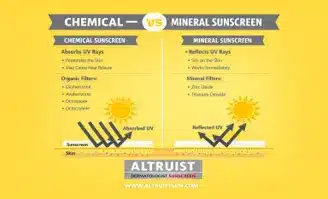
- Inorganic filters (e.g., zinc oxide and titanium dioxide) form a physical barrier on the stratum corneum. While they are traditionally described as physical blockers, modern photophysics shows they only reflect and scatter about 5% to 10% of incoming UV light, while absorbing the remaining 90% to 95%, converting it into harmless heat. They exhibit minimal systemic absorption and excellent skin tolerance. However, relying exclusively on inorganic filters presents significant formulation challenges, making it difficult to achieve lightweight textures with sufficiently high UVA protection factors.
- Organic filters absorb UV photons and dissipate the energy as harmless thermal radiation. They are critical for achieving cosmetically elegant formulations, broad-spectrum compliance, and superior coverage across the entire UV spectrum.
Consequently, hybrid formulations leveraging both filter types often yield the highest patient compliance, combining optimal broad-spectrum protection with cosmetic acceptability. Regarding systemic absorption, while certain laboratory studies have detected trace levels of specific organic filters in the bloodstream under maximized application conditions, detection does not equate to clinical toxicity. For example, compounds such as Octocrylene have undergone rigorous toxicological evaluation. The Scientific Committee on Consumer Safety (SCCS) deems Octocrylene entirely safe for cosmetic applications within approved regulatory limits (it is typically formulated well below the EU-permitted maximum threshold of 14.6%). While contemporary discussions among dermatologists focus on the degradation of older formulations into trace amounts of benzophenone over time, properly stabilized and fresh formulations pose no clinical risk and show no causal link to carcinogenesis. Ultimately, the clinical efficacy of any sunscreen depends entirely on consistent.
Myth #3: The Misconception That Photoprotection Is Only Required Seasonally
A significant portion of the patient population views photoprotection strictly as a seasonal intervention reserved for high-index summer days. This approach overlooks the fundamental differences in year-round UV kinetics:
- UVB radiation (responsible for erythema and acute DNA damage) peaks significantly during the summer months.
- UVA radiation (the primary driver of photoaging and long-term oxidative stress) remains relatively constant throughout the year. Crucially, UVA penetrates cloud cover and standard window glass, exposing patients during daily indoor or vehicular activities.
Photoprotection should be maintained year-round whenever daylight exposure exceeds 15 minutes. In my clinical and personal routine, I advise a daily morning application of at least SPF 30 to the face, ears, and neck from March through October, integrating it into the patient’s daily hygiene regimen. Shifting public habits toward routine, non-seasonal application is one of our most vital preventative goals.
Myth #4: The Fallacy That a Single Morning Application Provides All-Day Protection
Many patients assume that a single morning application provides sufficient photoprotection for the duration of the day. However, UV filters are subject to photo-degradation, and the protective film is continuously compromised by sebum production, perspiration, friction, and moisture.
To sustain adequate UV filtration during prolonged outdoor exposure, reapplication is required every two hours. Clinical sub-optimization usually occurs due to three factors:
- Insufficient dosing: To achieve the nominal SPF indicated on the labeling, an application density of 2 mg/cm² is required. Most individuals apply a fraction of this amount, exponentially reducing the actual log-protection factor.
- Anatomical neglect: Areas such as the helix of the ear, the posterior neck, the décolleté, and the dorsum of the hands are frequently omitted.
- The high-SPF paradox: Patients often assume a high SPF (such as SPF 50+) acts as a time-extended barrier. SPF defines the magnitude of UVB filtration at the time of application, not the duration of the formulation’s stability on the skin.
Myth #5: The Assumption That Affordable Sunscreen Equals Lower Formulation Quality
Within consumer dermatology, there is a pervasive bias that product retail price correlates directly with clinical efficacy and safety. In the context of European photoprotection regulations, this assumption is false.
All sunscreens marketed within the European Union must strictly comply with identical statutory standards governing safety, stability, and broad-spectrum efficacy. Price differentials are rarely driven by the cost of active UV filters or formulation quality; instead, they reflect corporate overheads, luxury retail placement, celebrity endorsements, and multi-million-pound marketing campaigns.
When a formulation optimizes these non-essential commercial expenditures, manufacturing high-tier, dermatologically compliant photoprotection at an accessible price point becomes entirely feasible. From a public health perspective, effective sun protection must be treated as an accessible preventative healthcare necessity rather than a premium luxury commodity.
Kasten bitte nicht zu dunkel:
Making Sun Protection Accessible to All
Every person deserves an equal opportunity to be protected from the sun. That is why the focus is entirely on combating skin cancer through widespread education and affordable, high-quality sun care. This purpose-driven initiative bridges the gap between premium skincare and affordability, ensuring that protection is within everyone’s reach. The impact, however, goes beyond personal health: every single product sold funds vital donations to charities supporting children with albinism in Tanzania and throughout Africa. It is a collective effort to protect yourself while lifting up those who face the greatest risks. Discover the mission and the range at www.altruistsun.com.
Correspoding address
Dr. Andrew Birnieis (Founder of ALTRUST sunscreen) is a fully qualified Consultant Dermatologist, practicing at the East Kent Hospitals University NHS Foundation Trust and in private practice. He leads the Multidisciplinary Skin Cancer Team (Skin Cancer MDT) in the East Kent region.He is deeply committed to global medical education and healthcare development. Dr. Birnieis spent time in Durban, South Africa, establishing a skin cancer center to provide free treatment for people in need and to train local doctors. Additionally, he directs online dermatology courses for Cardiff University
.
References:
- European Cancer Information System (ECIS) | Joint Research Centre (2022).
- Cancer Stats Data Hub | Cancer Research UK.
- Autier, P. (2000). Do high factor Sunscreens offer protection from melanoma? Western Journal of Medicine, 173(1), 58.